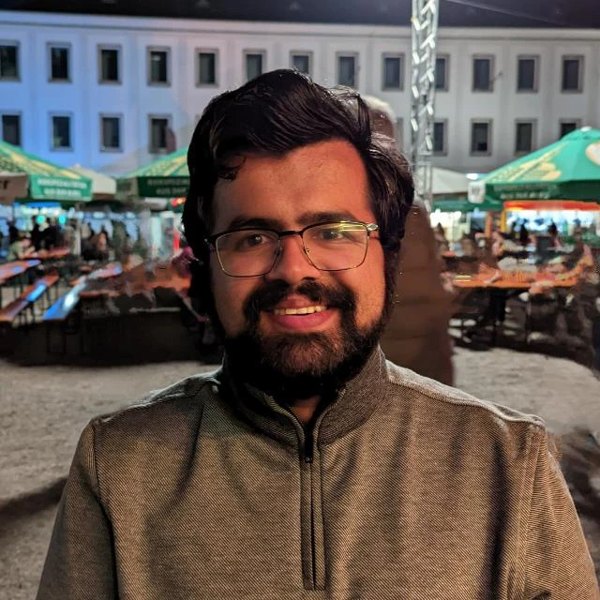
Dr. Paras Koundal
Postdoctoral Researcher
Recently joined the lab, bringing a background in astrophysics and machine learning to continuous biomanufacturing.
- Continuous biomanufacturing
- Integrated process modeling
- Machine learning
- Graph neural networks
- Monte Carlo simulation
Research
Paras works on the lab’s FDA project on continuous manufacturing of monoclonal antibodies (mAbs). The project combines experiments with mechanistic modeling of the upstream perfusion bioreactor and of continuous chromatography for mAb purification. Paras’s role is to integrate the upstream and downstream work into a single flowsheet model, so that the effect of bioreactor operating conditions on product quality can be followed through purification and used to compare and optimize operating scenarios.
Background
Before joining the lab, Paras was an astrophysicist and machine-learning researcher with the IceCube Collaboration, working on cosmic-ray composition, radio detection of cosmic-ray air showers, and neutrino oscillations. That work built physics-driven machine-learning pipelines, including graph neural networks for reconstruction and classification, CNNs for time-series denoising, and large-scale Monte Carlo simulation production on HPC systems.
- Postdoctoral Researcher (astroparticle physics & ML, IceCube Collaboration) · University of Delaware (2023–2026)
- Ph.D. Researcher · Karlsruhe Institute of Technology, Germany (2019–2023): led research on physics-driven machine learning for particle identification and signal classification of signals detected with photomultiplier tubes (PMTs), and proposed new edge-connection policies for graph neural networks, published in conference proceedings.
- BS-MS with Major in Physics · IISER Mohali, India (2014–2019): worked on particle-physics simulation production and on estimating the probability of detecting neutrinos at observatories, with research internships in India and abroad.
Selected Publications
- Koundal, P. Machine learning driven reconstruction of cosmic-ray air showers for next generation radio arrays. PoS ICRC2025:309 (2025). doi:10.22323/1.501.0309
- Koundal, P. and Torres-Gomez, V. Determining the orientation of radio antennas at the South Pole using Galactic noise measurements. PoS ICRC2025:308 (2025). doi:10.22323/1.501.0308
- Koundal, P. Cosmic-Ray Composition with IceTop and IceCube using graph neural networks. PoS ICRC2023:334 (2023). doi:10.22323/1.444.0334
- Koundal, P. Cosmic-Ray Composition analysis at IceCube using Graph Neural Networks. PoS ECRS2022:085 (2022). doi:10.22323/1.423.0085
- Koundal, P. Graph Neural Networks and Application for Cosmic-Ray Analysis. PoS DLCP2021:004 (2022). doi:10.22323/1.410.0004
- Koundal, P., Plum, M. and Saffer, J. Study of mass composition of cosmic rays with IceTop and IceCube. PoS ICRC2021:323 (2021). doi:10.22323/1.395.0323
- Talk: Koundal, P. Composition Analysis of cosmic-rays at IceCube Observatory, using Graph Neural Networks. Workshop on Machine learning for Cosmic-Ray Air Showers, Delaware, USA (2022). doi:10.5281/zenodo.6439650
- Link, K., Tokareva, V., Haungs, A., Kang, D., Koundal, P., Polgart, F., Tkachenko, O., Wochele, D., and Wochele, J. Online masterclass built on the KASCADE Cosmic Ray Data Centre. PoS ICRC2021:1378 (2021). doi:10.22323/1.395.1378
Plus 100+ IceCube Collaboration publications; see Google Scholar.
Projects
- Physics Inspired ML & AI: Developing architecture as well as loss-level physics inspired inductive biases for Graph Neural Networks, CNN and other ML methods. Development of pipelines and models for reconstruction of Extensive Air Showers (EAS) for the Nobel Prize winning IceCube Observatory in Antarctica.
- ProofSearch: Search, filter and trace the 722 AI-written math manuscripts in OpenAI’s openai/math release, with Lean verification status, dependency chains, public errata and a built-in research assistant.
- MapMyMind: Ultimate visual workspace for ideation, drawing, mind-mapping, and productivity.
- AutoML-Research: Autonomous ML experimentation for any project. Inspired by Karpathy’s autoresearch: the same constraint-driven experiment loop, adapted to work with any ML project, any framework, any AI agent.
- NotesGutter (2200+ downloads): Anchors rich markdown notes and infinite-canvas drawings to your code, without making your code messy.
- TalkToCode (public soon): Local-first AI coding assistant. Chat with your codebase privately using RAG and open-source LLMs.
- Job Tracker (7000+ jobs tracked across users): Track job applications with one click. Never lose track of where you applied.
- GitOn: A feature-rich, deeply integrated Git extension designed to supercharge your version control workflow.
- Shello & ShelloHub: Turns any Linux server into a secure, browser-accessible terminal, bypassing the need for VPNs, port forwarding, or root privileges. Also a combined dashboard to manage multiple Shello instances.
- ShelfScan (public soon): Scan any shelf to automatically read book titles, categorize, give ratings etc and locate any specific item on the shelf. This is built out of pain of finding good books at GoodWill.
- GPT Search: Prompt ChatGPT directly from your browser’s address bar.
- Git Notes: Context-aware notes for your GitHub repositories.
- Training Script Runner: Stop “fat-fingering” terminal arguments.
More on GitHub and paraskoundal.com.
Education
- Ph.D. · Karlsruhe Institute of Technology, Germany (2019–2023)
- BS-MS with Major in Physics · Indian Institute of Science Education and Research (IISER) Mohali, India (2014–2019)
Awards & Service
- Among Top-4 Voted Posters, Eastern European Machine Learning Summer School (EEML2022)
- INSPIRE scholarship, Department of Science and Technology, India
- 3rd position internationally, NASA Ames Space Settlement Contest, 2012
- Reviewer for Astroparticle Physics, Journal of Cosmology and Astroparticle Physics (JCAP), and MDPI journals (Mathematics, Information, Future Internet)
- Main organizer, IceCube MasterClass at the University of Delaware
- Founder, DIYA (Discussion among Indian Youth doing Astroparticle physics), a community for young Indian astroparticle physicists · Join